Too young to listen
Young grandchildren can’t yet appreciate the stories their grandparents most want to share.
Valinor helps people preserve their legacy. An AI interviewer asks about their life and follows up on every answer; the stories become a storybook with photos and recordings, and a digital twin their children and grandchildren can chat with for years to come. I designed it end to end — the web app, the gifting flow and the admin panel.
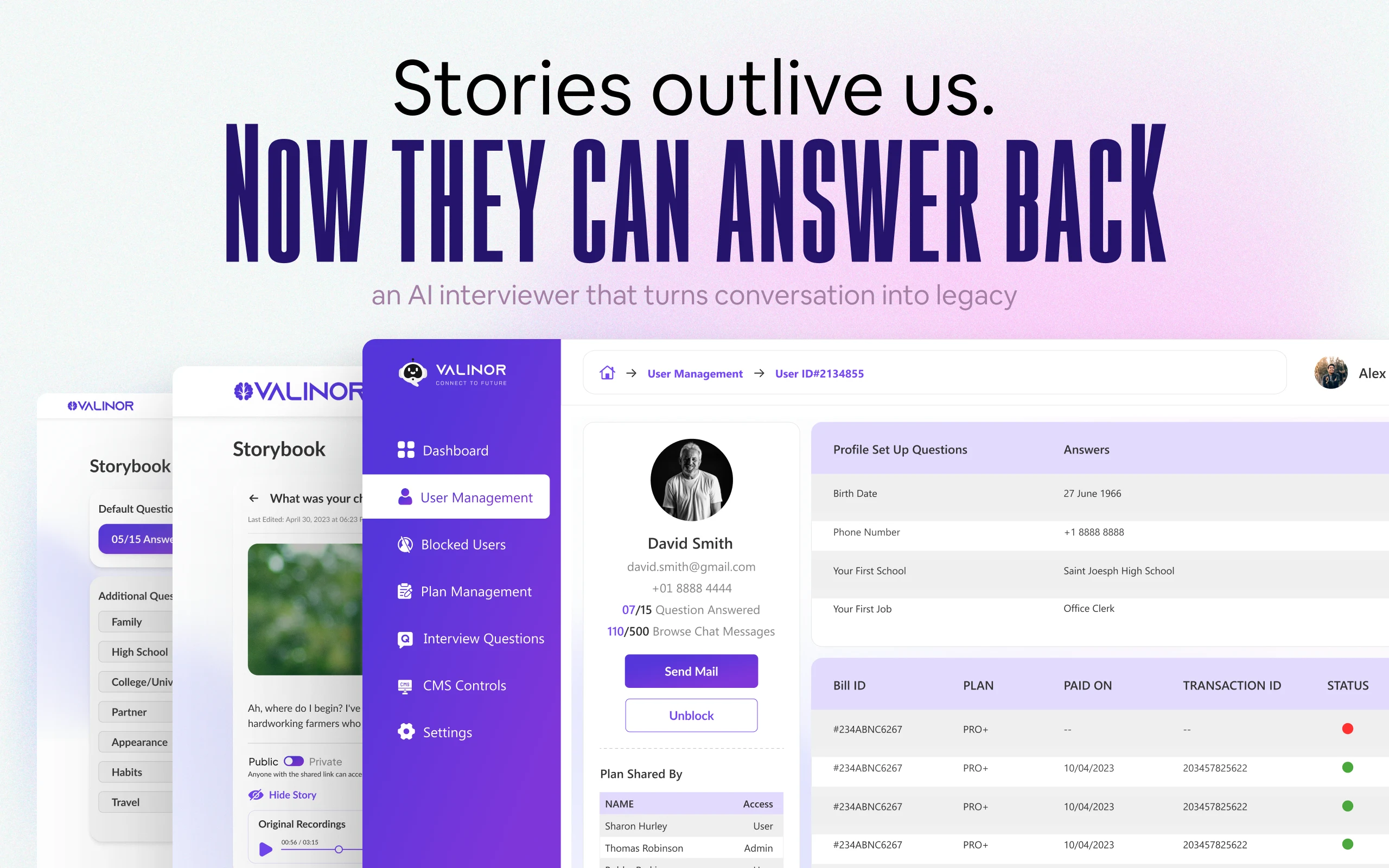
Valinor is an AI legacy platform. Instead of writing a memoir, people simply talk: an AI interviewer asks about their life, follows up on what they say and turns the answers into a storybook. Those same stories power a digital twin — a chatbot their family can ask anything, in their voice and style.
Two people, often decades apart. The storyteller — usually 60+ and not always comfortable with technology — and the family: children who often buy Valinor as a gift for a parent, and grandchildren who may be too young to listen today but will want those stories later.
People want to pass on their history and what life taught them. Their grandchildren are often too young to take it in — and by the time they are ready, it may be too late to ask.
Young grandchildren can’t yet appreciate the stories their grandparents most want to share.
Long writing sessions are tiring and, for many older adults, physically painful — so stories never get written down.
The biggest barrier wasn’t technology. It was not knowing what to share or how to structure a life story.
Existing tools turn answers into a printed book or a family tree. None let a family actually talk with those memories.
A conversational AI can do what a curious grandchild would: ask, follow up and keep the story going.
Adult children want their parents’ stories kept. Making Valinor something you can give turned a hard ask into a present.
An online survey of 150 people aged 60+, then an open card sort of 30 life topics with older participants.
A primary persona grounded in the findings, plus a teardown of StoryWorth and Ancestry.
Four concepts for recording and three for the family chat — tested and narrowed down in a two-month first design phase.
The interview, storybook, digital twin and sharing; gift subscriptions and plans; and the admin panel that runs it all.
Iterated on the core experience with real use — and lifted engagement by 30%.
It was the company’s first AI product, so we didn’t guess. We asked older adults directly how they feel about technology, storytelling and talking to an AI.
Most people preferred to tell their stories out loud. Writing was slow, tiring and for some physically painful — voice had to come first.
Not knowing what to share was the biggest barrier. Guided questions and AI follow-ups gave people a place to start.
People wanted short sessions of 10–15 minutes and gentle prompts, not long sittings.
In the card sort, family life and personal growth were the strongest themes, then work and career — that became the question structure.
“I designed Valinor from the first survey to the admin panel — the conversation design, the storybook, the digital twin, the gifting flow and the visual identity.”
Everything I designed across the app and the admin panel.
“Who will be preserving their stories?” — yourself or someone else — then a short profile set-up and a mic test.
Parent questions with AI follow-ups, progress like “05/15 answered”, regenerate a question or skip it.
Record an answer and Valinor converts it to text you can edit before saving — or simply type.
Fifteen core questions, themed sets like family, school, partner and travel, hidden questions and your own.
Every answer as a story with photos, original recordings, word counts and edit history.
Each story is public or private, can be hidden, and is shared by SMS, email or link.
A chatbot trained on your stories that answers your family in your words, with sample prompts to start.
Invite relatives with a relationship and an access level — viewer or admin — and manage who sees what.
Give Valinor as a gift with a scheduled date and a message; plans, a free trial and billing history.
Revenue and trial metrics, users and blocked users, plans, interview questions, CMS pages and settings.
The first and most important job was helping people record their experiences in a way that suited their age and their comfort with technology. Forms and blank text boxes were out: they recreate exactly the pressure that stopped people writing in the first place.
So recording became an interview. Valinor asks a parent question, then an AI follow-up based on the answer — the way a curious grandchild would. People can answer out loud; Valinor converts the recording to text they can check before saving. A mic test, a progress count and the option to regenerate or skip a question keep every session short and safe.
I sketched four layouts: a single chat, a sequence of cards, stacked cards and a split view. Testing pointed to a focused, one-question-at-a-time interview, with the full list of questions living in the storybook — so people always know where they are without being overwhelmed.
Why this, not thatI didn’t make the AI ask everything at once. A long list of questions felt like homework; one question and a thoughtful follow-up felt like someone listening.
Answers on their own are just text. People wanted to see their life take shape — and to decide who gets to see which part of it.
Every answer becomes a story in the storybook: the question, the words, the photos that go with it and the original recordings, so the family can hear the real voice behind the text. Word counts and edit history show progress without turning it into a score.
Privacy sits right beside each story, not hidden in settings. A story can be public or private, hidden, or shared by SMS, email or a link — because some memories are for everyone and some are not.
Why this, not thatI kept privacy on the story, not in a settings page. Decisions about what to share happen while reading a memory — that’s where the control belongs.
Recording was only half of the promise. The stories had to reach the family — in a way that works whether a grandchild is four or forty.
The answer was a digital twin: a chatbot trained on the storyteller’s own stories, which answers questions the way they would. Family members get access through an invite with their relationship and an access level, then simply ask — starting from sample prompts if they don’t know where to begin.
My first idea reused the interview layout for chatting, for consistency. Testing showed it was too complex for a simple conversation, so I switched to a clean, focused chat. I also tried showing the storyteller’s photo beside the chat, but it took too much space from the conversation itself.
Why this, not thatI didn’t keep one layout for both journeys. Consistency mattered less than fit: an interview needs structure, but talking to your grandparent should feel like just that.
A product like this lives or dies on what happens behind the scenes. I designed the admin panel so a small team could run Valinor without a developer for every change.
Pricing, interview questions and website pages change without a release, and every user’s plan, payments and answers are one click away.
Sales revenue, subscriptions, trial users and new sign-ups with trial and subscription dates.
Every user with plan, payment status and actions, plus a separate list to unblock accounts.
Profile answers, questions answered, chat messages used, plan sharing and billing history.
Edit monthly and yearly prices, discounts, members and chat limits for each plan.
Add, edit and show or hide the questions every storyteller is asked.
Edit website pages in a visual or HTML mode, show or hide homepage sections, and set reminder and data-retention limits.
Many storytellers were new to apps like this. Voice answers, a mic test, large type and short sessions lowered the bar to a first story.
The interface had to stay minimal and current so grandchildren would actually want to use it.
Stories, photos and recordings had to stay safe and shareable for years — with clear control over who sees what.
The twin had to answer in the storyteller’s own words and style, without feeling eerie.
Often the person paying isn’t the person telling the stories. Gifting, scheduled dates and invites served both.
It was the company’s first AI project, so every conversation pattern was designed and tested from scratch.
A visual language that respects older users and still feels fresh to younger ones — anchored by a friendly robot guide.
+30%
User engagement after the redesign of the core experience.
Source: product analytics, Biz4GroupWritingTalking (from Writing to Talking)
People record by speaking with an AI that asks and follows up, instead of facing a blank page.
Source: shipped productTextStorybook (from Text to Storybook)
Answers become stories with photos, original recordings and per-story privacy.
Source: shipped productOne-wayTwo-way (from One-way to Two-way)
Families don’t just read the stories — they ask questions and get answers from the storyteller’s twin.
Source: shipped productHard askGift (from Hard ask to Gift)
Children can give Valinor to a parent, scheduled for a birthday, with a personal message.
Source: shipped productDeveloperAdmin (from Developer to Admin)
The team changes prices, questions and website pages without a release.
Source: shipped productThe survey changed the product: voice answers came straight from older adults telling us writing was hard.
The interview and the chat needed different layouts. Forcing one onto both made the simpler task harder.
The storyteller and the person paying are often different people. Gifting made the product easy to say yes to.
Choices made for older users — clarity, voice, short steps — made the product better for everyone.
Valinor is client work under NDA, so the product isn’t public. I’m happy to walk you through it on a call.
Stories outlive us.
Now they can answer back.
Valinor turns a life’s memories into a storybook and a conversation the family can keep having. Next, I’d explore the twin answering in the storyteller’s recorded voice, and family timelines that grow as more relatives add their stories.